
From Participation to Influence: How Women Are Transforming the Energy Sector


By Priya Veeranna
Southern Africa’s energy transition is often framed in terms of infrastructure, investment, and technology. The focus is typically on expanding generation capacity, improving energy efficiency, and strengthening grid resilience to support economic growth.
But beyond these technical priorities, a quieter transformation is underway, one that is reshaping how the sector operates and how decisions are made. As global evidence increasingly shows, the energy transition is not only a technological shift, but also a workforce transformation that will determine who participates in, and ultimately shapes, the future of energy systems. Across the region, women are moving beyond participation and into positions of influence. They are not only contributing to the energy sector; they are actively transforming it.
A Shift from Inclusion to Impact
For many years, the conversation around women in energy has centred on inclusion, ensuring representation in a sector historically dominated by men. While this remains important, it is no longer sufficient.
The more relevant question today is not whether women are present in the sector, but whether they are positioned to influence outcomes. Current data highlights both progress and persistent gaps. Globally, women make up only about 20% of the energy workforce, with even lower representation in leadership roles. In South Africa, women account for approximately 33% of the energy workforce, yet only 19% hold board-level positions.
This imbalance is even more pronounced in technical fields. Women represent less than a quarter of STEM professionals in South Africa, and even fewer occupy senior technical or executive roles in the energy sector. This trend is not unique to South Africa. Even within the renewable energy sector, often seen as more progressive, structural imbalances persist. The International Renewable Energy Agency (IRENA) reports that women account for approximately 32% of the renewable energy workforce (Figure 1) , but their representation drops to 28% in STEM roles and just 19% (Figure 2) in senior leadership positions.
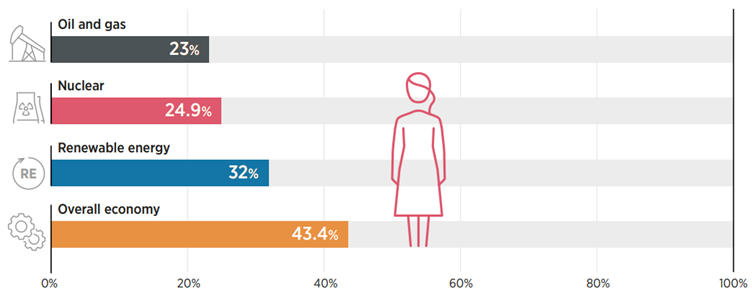
Figure 1:Female share of employment across the energy sector and overall economy (IRENA Global Survey; Hughes-Plummer et al., 2023)

Figure 2: Female share of full-time employment in renewable energy, by role (IRENA Global Survey; Hughes-Plummer et al., 2023)
These figures reinforce a critical point: participation alone does not equate to influence.
What Transformation Looks Like in Practice
Transformation in the energy sector is not abstract. It is visible in the day-to-day decisions that shape how energy systems are designed, implemented, and managed. It is seen in women leading energy efficiency initiatives that reduce operational costs and improve industrial performance. It is reflected in women contributing to policy frameworks that guide national energy strategies. It is present in boardrooms where sustainability, governance, and long-term resilience are being prioritised. In South Africa, there are tangible examples of this shift. Women are increasingly active across the renewable energy value chain, from project development to executive leadership. At industry level, initiatives such as gender diversity tracking in the renewable sector are beginning to formalise progress and introduce accountability.
At the same time, women-led enterprises and participation in emerging sectors such as hydrogen and clean energy technologies are gaining traction, supported through targeted programmes and partnerships with industry and government. Importantly, this transformation is unfolding at a critical moment. Global projections indicate that renewable energy employment could grow to tens of millions of jobs by 2030, creating a significant opportunity to reshape participation and leadership from the outset. In a discipline such as energy efficiency, where technical performance, behavioural change, and financial decision-making intersect, diverse perspectives are particularly valuable. Women operating in these spaces are contributing not only technical expertise, but also systems thinking that strengthens how solutions are developed and implemented. Transformation, in this context, is not about representation alone. It is about influence over the decisions that determine how the sector evolves.
The Role of Platforms That Enable Change
As this shift gains momentum, the importance of structured platforms that support women’s advancement becomes increasingly clear. Organisations such as Southern African Females in Energy Efficiency (SAFEE), under the umbrella of the Southern African Energy Efficiency Confederation, are playing a critical role in this ecosystem. By creating spaces for engagement, visibility, and collaboration, these platforms are helping to bridge the gap between participation and leadership.
Across the sector, similar initiatives are emerging. Industry bodies, training programmes, and professional networks are actively working to close the skills gap and accelerate the growth of female leadership in renewable energy and engineering fields. These efforts are not only about equity, they are about strengthening the sector’s overall capacity.
The Cost of Slow Progress
While there are encouraging signs of progress, the pace of change remains a concern. The energy sector is under increasing pressure to deliver solutions that are not only technically sound, but also economically viable and socially responsive. Achieving this requires access to the full spectrum of available talent.
IRENA cautions that without improving gender balance, the energy transition itself risks being constrained by skills shortages, limited innovation, and a lack of diverse perspectives. In a rapidly expanding sector, failing to fully utilise available talent is not only inefficient, it is a structural risk to achieving energy and climate goals. In a region where energy challenges are closely linked to economic development, the cost of slow progress is not theoretical, it has tangible implications for growth, competitiveness, and sustainability.
Moving from Intent to Action
If the sector is to accelerate this transformation, the focus must shift from intent to deliberate action. Industry leaders must create environments where women are not only included, but are trusted to lead complex projects and influence strategic direction. This requires more than policy statements; it requires measurable commitments and accountability. Institutions must strengthen pathways into the sector through targeted education, training, and skills development, particularly in engineering and technical disciplines.
Closing these gaps requires coordinated interventions, including inclusive workplace policies, mentorship programmes, leadership development, and targeted skills investment. These are practical levers that can accelerate both gender equality and sector performance. Experienced professionals, both men and women, must actively contribute to mentorship and knowledge transfer, ensuring that the next generation is equipped to take on leadership roles. At the same time, women within the sector have an equally important role to play. Supporting one another, sharing opportunities, and amplifying each other’s contributions are critical actions that strengthen collective progress.
A Sector Being Shaped in Real Time
The transformation of the energy sector is not a future aspiration. It is already happening. Women across Southern Africa are contributing to more efficient industrial systems, shaping policies that guide national priorities, and influencing how organisations approach sustainability and performance. Their impact is being felt across the value chain. The opportunity now is to accelerate this progress, to ensure that influence becomes the norm rather than the exception.
The energy transition will ultimately be defined not only by the infrastructure that is built, but by the leadership that shapes it. As more women move into positions of influence, the sector stands to benefit from stronger decision-making, greater innovation, and more resilient outcomes. The question is no longer whether women are part of the energy sector. It is whether the sector is moving fast enough to fully realise the value they bring.