
Sharpening the Lighting Circular Economy: Moving Beyond Linear Inefficiencies


Based on the presentation by Bjorn Smidt-Hart at the SAEEC Conference, October 2025.
In an era where sustainability is paramount, the lighting industry faces a critical turning point. While “circular economy” has become a buzzword in manufacturing and energy sectors, recent industry analysis suggests that current practices may still be heavily rooted in linear inefficiencies. At the recent SAEEC Conference025, Bjorn Smidt-Hart presented a compelling case for “Sharpening the Lighting Circular Economy,” arguing that without significant changes in design, regulation, and consumer behaviour, the industry risks perpetuating a “take-make-waste” cycle disguised as progress.
The Illusion of Circularity
The circular economy is defined by its ability to maximize the reusability and longevity of materials, contrasting sharply with the linear economic system where products are designed with a finite lifespan ending in waste. Ideally, a circular model creates a closed regenerative loop. However, the presentation highlights a phenomenon of “Linearity within the Circularity”, where the infrastructure supports recycling in theory, but the products themselves are designed for the landfill.
True circularity should support multiple Sustainable Development Goals (SDGs), including Affordable and Clean Energy (SDG 7), Responsible Consumption (SDG 12), and Climate Action (SDG 13). Yet, the reality of modern lighting products often falls short of these interconnected goals.
Figure 1: The ideal circular economy model. (Residual waste)
Figure 1 emphasizes a regenerative loop involving reuse, repair, and recycling, moving away from the linear “raw materials to landfill” trajectory.

The Brakes on Lighting Circularity
Several technical and economic barriers act as “brakes” on the transition to a fully circular lighting economy. The primary culprit is product design. Modern LED bulbs, while energy-efficient compared to incandescent predecessors, often suffer from “planned obsolescence” or poor engineering that limits their circular potential.
1. Design and Lifespan Discrepancies A significant issue cited is the gap between labelled claims and actual performance. While packaging may promise longevity, many units fail in under 15,000 hours (less than 5 years of service), suffering from high mortality rates. Furthermore, technical inefficiencies persist; for example, some 9W LED bulbs operate with a Power Factor (PF) of just 0.5, resulting in apparent power usage greater than 18VA. Despite the efficiency reputation of LEDs, up to 60% of energy can still be lost to heat in poorly designed units.
2. Material and Manufacturing Barriers The physical construction of modern lighting often prevents reuse. Many units are designed as “single-use plastics,” utilizing resins and glues that are not reusable, effectively sealing the fate of the components inside. The housing materials, often Polycarbonate (PC) plastics chosen for durability and heat resistance, are difficult to recycle compared to PET or HDPE, requiring intensive investment to reclaim.
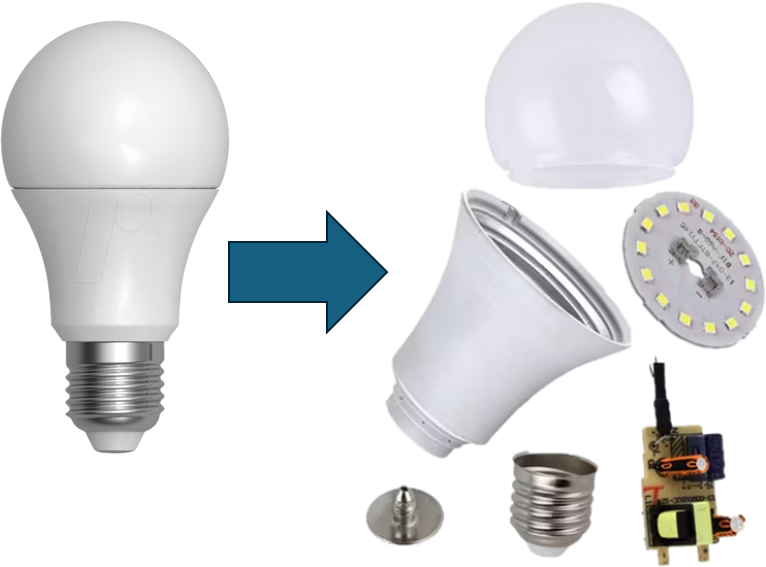
Figure 2: An exploded view of a typical LED bulb.
The extensive use of non-eco-friendly glues and integrated designs makes separating these components for the “4R strategies” (Reduce, Reuse, Recycle, Repair) technically difficult and economically unviable.
The Need for a Regulatory and Industrial Push
To sharpen the circular economy, the industry requires a coordinated push involving government regulation, standardization, and professional development.
Standardization and Modularity A key technical recommendation is the adoption of global standardisation of components, such as Zhaga, a consortium that sets standardized interfaces for LED luminaire components. By standardizing LED light engines, modules, and drivers, the industry can move toward modular products that can be repaired or upgraded rather than discarded. This approach promotes useful product life well beyond the initial label claim.

Figure 3: Example of Zhaga based component standardisation and sizing
Figure 3: Standardization of components (Light engines, Drivers, Sensors) facilitates repair and maintenance, essential pillars of a circular economy.
Government and Policy Engagement The presentation calls for a review and revision of policies, specifically Minimum Energy Performance Standards (MEPS). It advocates for financial models and that promote effective circularity rather than just low initial product and energy costs, suggesting incentives for local industry and retail to produce and stock circular-compliant products.
Professional Accountability There is a pressing need to grow local professionals capable of best-practice product design. This includes holding stakeholders accountability for poorly designed products, non-compliant lighting designs, and inefficient lighting service.
Shifting Consumer Behaviour
Finally, technical solutions must be matched by a shift in consumer behaviour. The market is currently driven by “consumer-oriented convenience”, often at the expense of efficiency. The industry must counter misleading sales pitches with facts and provide clear awareness, benefits and incentives for consumers to participate in possible “reward based” e-waste collection and recycling programmes.
Conclusion
The transition to a circular economy in lighting is not merely about recycling; it requires a fundamental sharpening of how products are designed, regulated, and consumed. As Smidt-Hart concluded, a paradigm shift is required to “Invest Now” and “Act Now” to save the future. The goal is clear: efficiency must lead directly to sustainability.